Database Cloning and Containers
On demand database clones with containers provide Agent and application developers with production database copies (with optional masking) for agentic AI and software dev/test.
Writable database copies are delivered in seconds to new Docker containers or existing database instances, with each copy occupying <100 MB. Cloned database environments are ideal for Continuous Integration, database development and test, ETL jobs, reporting, and more.
The benefits of database cloning include:
- Over 95% reduction in storage
- Clones of Oracle, SQL Server, Postgre, MySQL, and more
- Faster, more thorough testing
- Responsive production debug and support with point-in-time and near real-time production environments
- Compliance with centralized image repo of lower level environments, with security policies built-in.

Point-in-time and near real-time databases
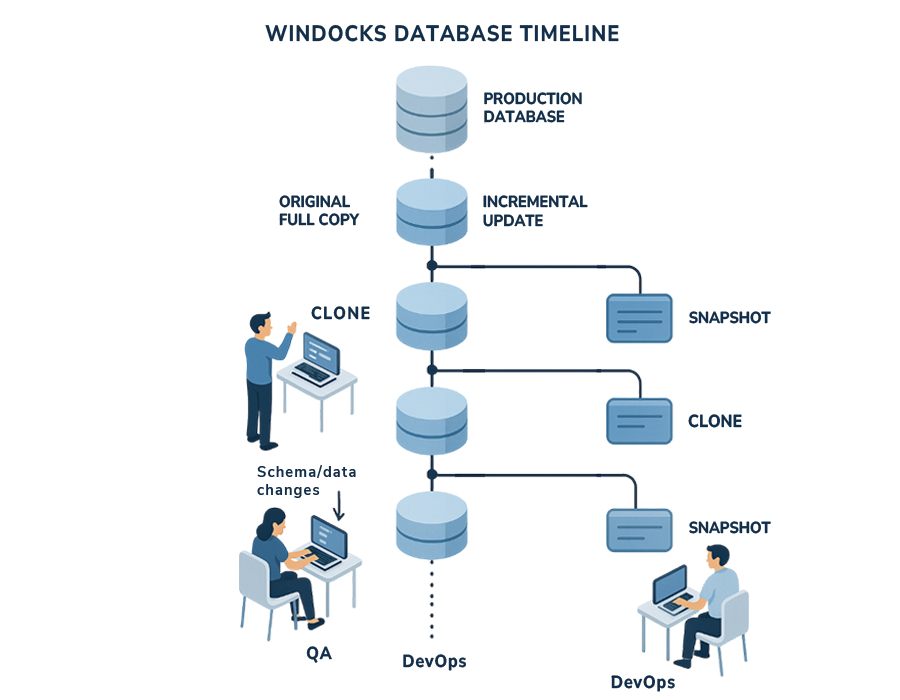
Database virtualization is based on a full byte copy of the database(s) in an image, created by restoring backups, database files, or via an Oracle stand-by instance. Images scale to deliver databases up to 50 TB or more, and can include dozens of databases. Data masking, user permissions, Git operations, and other steps are built in, or applied as clones are delivered, ensuring data is ready for use.
LangGrant database virtualization supports a “database timeline” and point in time environments on Linux and Windows. Writable snapshots enable a user environment to be saved as a new image and shared with a larger team.
Database refresh
Database refresh is the process of getting incremental changes from the primary / production database and making the current primary / production databases available for testing, development, DevOps, machine learning model test and training. Windocks database refresh is available for SQL Server and Oracle. Build an image once from the full primary databases or backups just once. After that Windocks automatically refreshes the image with incremental changes from primary / production.
Database refresh for Oracle
Database refresh for Oracle with an Oracle Docker container that stays in sync with the primary / production. Build point in time images instantaneously using the synced data in this container. From these point in time images, you can self service Oracle database clones in docker containers or Oracle instances. This unique architecture provides point in time database clones for testing, DevOps, and MLOps without requiring complex infrastructure with staging servers.
Database refresh for SQL Server - video
Explore LEDGE server capabilities
Orchestration: automated database context
LEDGE automatically delivers complete database context for LLMs to comprehend multiple databases simultaneously at scale. Like a skilled engineer, once an LLM understands databases it can contribute to solution design.
Orchestration: analytic plan
LEDGE binds LLMs to deliver accurate analytic plans for user queries. Plans are saved, easily validated and modified, and run to deliver analytics data within minutes of the user query.
Governance
PII safeguards, authorization controls, data residency rules, firewall restrictions, and token-governance policies are built-in by design. No sensitive data leaves governed systems.

Plan management
LLM generated plans are saved, easily reviewed and validated, modified, and executed, for LLM use that is transparent, explainable, and repeatable.
Database cloning and containers
On demand database clones with containers provide Agent developers with production database copies (with optional masking) for agentic AI dev/test.
Database subsetting and synthetic data
Database subsetting with synthetic data provides added context for working with complex multi-database environments.